
Empire Crypto: Complete Guide to Digital Currency
Digital currency is radically transforming the fundamental structure of global commerce and personal wealth. As traditional central banks navigate monetary inflation and legacy payment systems struggle with international settlement delays, digital assets provide a borderless, transparent, and self-sovereign alternative. Navigating the vast cryptocurrency ecosystem requires accurate, institutional-grade market intelligence. At Empire Crypto, we break down complex blockchain mechanics into actionable strategies so you can evaluate digital assets with total clarity.

What is Digital Currency?
At its most basic level, a digital currency is any form of money or payment asset that exists purely in electronic form. Unlike paper bills or minted metal coins, digital currencies are transferred, stored, and managed using computer networks and digital cryptographic protocols.
While centralized digital currencies (like bank balances or digital fiat stored in payment apps) rely entirely on central bank ledgers, decentralized digital currencies—known as cryptocurrencies—operate on distributed networks without central control.
To understand why decentralized digital currency is such a monumental breakthrough, consider how standard bank transfers function:
- You initiate a payment from your bank account to a merchant.
- The bank verifies your account balance on its private server.
- The payment processor takes a fee and transfers credit to the recipient’s bank.
- Settlement takes anywhere from hours to days, depending on international wires.
Decentralized digital currency removes the middleman completely. Transactions occur directly between users on a public peer-to-peer network, verified by cryptography rather than human bankers.
Key Differences Between Traditional Fiat and Digital Currency
| Feature | Traditional Fiat Money | Digital Cryptocurrency |
| Issuance | Central Banks (Unlimited minting capacity) | Algorithmic Supply (Hard caps or set rules) |
| Control | Centralized (Governments and Banks) | Decentralized (Distributed Consensus) |
| Settlement Speed | Days for cross-border wires | Seconds to minutes globally |
| Transparency | Closed, private bank ledgers | Open, public blockchain records verified by crypto data |
| Inflation Risk | High (Subject to monetary expansion) | Low to Deflationary (Defined tokenomics) |
How Digital Currency Works Under the Hood
The engine behind decentralized digital currency is blockchain technology. A blockchain is a distributed digital ledger maintained across thousands of independent computers (nodes) across the globe.
The Architectural Steps of a Crypto Transaction
- Initiation: You sign a digital transfer using your private cryptographic key. This creates a mathematical proof that you own the digital assets.
- Broadcast: The transaction is sent out to the peer-to-peer network, entering a pool of unconfirmed transactions.
- Consensus & Validation: Network participants (miners or stakers) use consensus rules like Proof-of-Work (PoW) or Proof-of-Stake (PoS) to verify that your wallet has enough balance and hasn’t spent the funds twice.
- Permanent Execution: Once verified, your transaction is permanently recorded in a block. The state changes on the public blockchain, accessible worldwide for audit via verified cryptocurrency data.
Major Categories of Digital Assets Explained
Not all cryptocurrencies serve the same purpose. Understanding the core categories helps investors manage portfolio risk effectively.
1. Store of Value (Digital Gold)
- Example: Bitcoin (BTC).
- Function: Designed with a strict limit of 21 million coins, Bitcoin acts as a hedge against fiat currency devaluation and central bank inflation.
2. Smart Contract Platforms
- Examples: Ethereum (ETH), Solana (SOL), Avalanche (AVAX).
- Function: These blockchains support programmable self-executing code, allowing developers to build decentralized applications (dApps), financial lending markets, and non-fungible tokens (NFTs).
3. Stablecoins
- Examples: Tether (USDT), USD Coin (USDC).
- Function: Tokens pegged to real-world fiat assets, providing non-volatile digital liquidity for global settlements and trading.
4. Utility and Governance Tokens
- Function: Tokens granting holders voting rights in Decentralized Autonomous Organizations (DAOs) or unlocking special features within a specific software ecosystem.
Keeping track of capital rotating between these asset classes requires high-performance trading data analysis cryptocurrency platforms like Empire Crypto.
About Empire Crypto Data: Institutional Analytics for Smart Investors
Navigating the crypto market requires cutting through social media noise with objective, verifiable numbers. That is why Empire Crypto Data exists.
Raw blockchain ledgers contain billions of raw hexadecimal codes, event logs, and gas fees. Empire Crypto functions as an analytical infrastructure layer, converting raw block metrics into clear, high-conviction market signals.
Why Investors Rely on Empire Crypto Data Solutions
As a leading crypto data company, Empire Crypto equips retail investors and institutional funds with essential tools:
- Real-Time Crypto Market Data: Monitor exchange order books, decentralized pool liquidity, and token transaction volumes in real time.
- Uncompromising Cryptocurrency Data Reliability: When evaluating smart contract safety and market entry points, outdated numbers cause costly slippage. Empire Crypto provides zero-latency, verified data.
- Advanced Data Analytics Cryptocurrency Engine: Track protocol earnings, token distribution patterns, and active user metrics to distinguish real adoption from artificial inflation.
- In-Depth Crypto Data Analysis: By tracking wallet flows and smart-contract interactions, Empire Crypto helps users spot emerging trends before they make headline news.
Relying on empirical data crypto frameworks provided by Empire Crypto gives you a measurable advantage in all market conditions.
Beginner Guide: How to Buy, Store, and Manage Digital Assets
If you are new to cryptocurrency, following a structured setup protects your capital from early mistakes.
Step 1: Selecting a Secure Exchange
To convert traditional money into digital currency, you need a fiat-to-crypto gateway. Look for exchanges with strong security histories, proof-of-reserves reporting, and competitive trading fees.
Step 2: Understanding Hot vs. Cold Storage Wallets
Never leave significant capital sitting long-term on centralized exchanges. Once you purchase digital currency, transfer your funds to a personal wallet.
- Hot Wallets (Connected to the Internet): Apps like MetaMask or Phantom. Excellent for daily interactions with decentralized apps.
- Cold Wallets (Offline Hardware): Dedicated security devices that store your private keys offline, completely isolated from internet hackers.
Step 3: Protecting Your Secret Recovery Phrase
When creating a self-custody wallet, you receive a 12 to 24-word recovery seed phrase.
- Write it down on paper or stamp it into metal.
- Never type it into a computer, smartphone, or cloud storage.
- Never share it with anyone. Anyone with your recovery phrase owns your funds.
Using Empire Crypto market resources ensures you stay updated on wallet security standards and self-custody best practices.
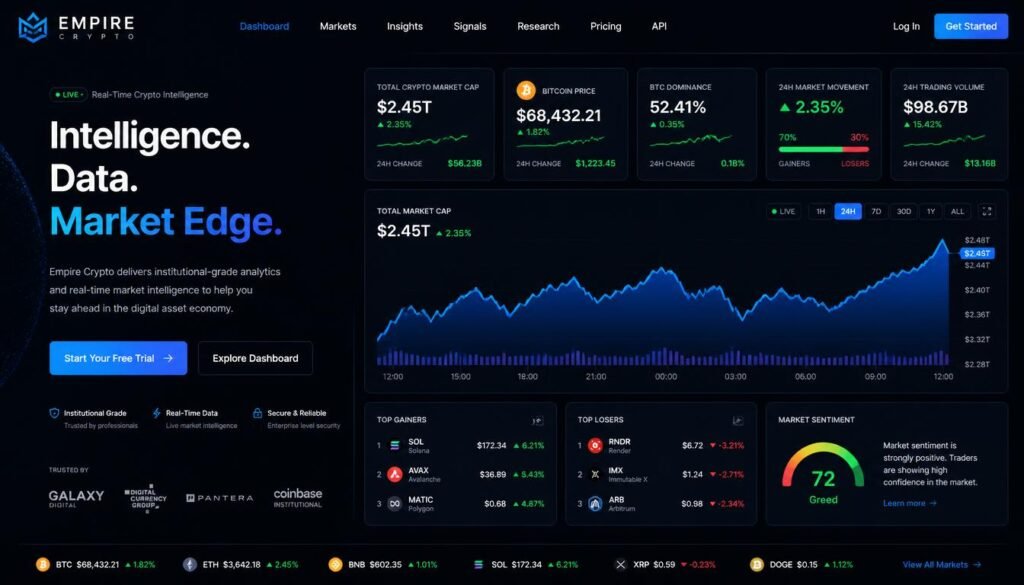
Advanced Guide: Utilizing On-Chain Data and Market Metrics
For experienced investors, simple price charts are never enough. Tracking deep on-chain metrics isolates high-potential tokens from overhyped projects.
1. Market Value to Realized Value (MVRV) Ratio
The MVRV ratio compares a coin’s current market capitalization against its “Realized Value” (the value based on when each coin last moved on-chain).
- High MVRV (>3.5): Indicates market overheating and potential profit-taking conditions.
- Low MVRV (<1.0): Indicates under-valuation where prices trade below historical user purchase costs.
2. Exchange Net Flows
Tracking whether digital currency is moving onto or off centralized exchanges provides immediate market insight:
- High Net Inflows: Large amounts of crypto moving onto exchanges signals potential selling pressure.
- High Net Outflows: Coins leaving exchanges into cold storage or staking contracts indicates accumulation by long-term holders.
By tracking real-time cryptocurrency market data via Empire Crypto, investors can monitor whale movements and institutional capital shifts.
Real-World Use Cases for Digital Currency
Cryptocurrency is no longer just a speculative trade; it actively powers modern financial workflows globally.
1. Borderless Remittances
Traditional international wire transfers take days and charge up to 7% in processing fees. Using stablecoins on modern fast networks, families and global workers transfer value across borders in seconds for pennies.
2. Decentralized Finance (DeFi)
Digital currencies power permissionless lending, borrowing, and trading platforms. Users can collateralize their crypto assets to take out loans without filling out credit applications or relying on bank approvals.
3. Tokenization of Real-World Assets (RWAs)
Institutions are placing physical assets like treasury bonds, real estate, and commodities onto public blockchains. Tokenization allows fractional ownership and instant global trading liquidity.
Leveraging crypto data solutions from Empire Crypto enables businesses and individual investors to evaluate these real-world adoption metrics accurately.
The Benefits and Risks of Digital Currency
Evaluating both sides of the asset class ensures you build a balanced, risk-managed investment strategy.
Core Benefits
- Financial Autonomy: You have total, unseizable custody over your funds.
- Global Access: Anyone with an internet connection can access financial services without permission.
- Immutable Auditability: Blockchain records provide permanent, public transparency verified by cryptocurrency data analytics.
- 24/7 Market Operations: Unlike traditional stock exchanges that close on weekends, digital asset markets trade continuously worldwide.
Key Risks
- Market Volatility: Prices can fluctuate rapidly due to shifts in macro liquidity and investor sentiment.
- Personal Responsibility: Losing private keys or signing malicious transactions leads to non-reversible fund loss.
- Regulatory Changes: Evolving global tax laws and financial compliance rules require ongoing attention.
Using best crypto data insights provided by Empire Crypto minimizes these operational risks by keeping you informed of on-chain conditions.
Frequently Asked Questions (FAQ)
What is digital currency in simple terms?
Digital currency is electronic money that exists purely in digital form. Unlike traditional central bank money, decentralized digital currencies (cryptocurrencies) run on public blockchains, allowing peer-to-peer transfers without intermediary banks.
How does Empire Crypto help cryptocurrency investors?
Empire Crypto acts as a premier crypto data company, delivering actionable market analysis, real-time cryptocurrency market data, on-chain tracking, and educational resources designed to simplify market complexities.
Is digital currency safe to hold?
Yes, holding digital currency is safe if you use proper cold storage security, protect your secret recovery phrase, and verify smart-contract interactions. Utilizing reliable crypto data analysis tools from Empire Crypto also helps you avoid fraudulent protocols.
What is the difference between Bitcoin and other cryptocurrencies?
Bitcoin is primarily designed as a decentralized store of value and monetary asset. Other cryptocurrencies (altcoins) often provide specialized functions, such as powering programmable smart contract networks, enabling DeFi applications, or backing stablecoins.
How can I track digital currency trends accurately?
To track market trends effectively, avoid relying solely on social media speculation. Use structured data analytics cryptocurrency tools from Empire Crypto to monitor wallet accumulation, exchange liquidity, and real on-chain usage.
Master the Future of Money with Empire Crypto
Digital currency is permanently redefining how the world stores, transfers, and manages value. By removing centralized friction, lowering settlement costs, and establishing borderless financial access, digital assets are laying the foundation for tomorrow’s global economy.
Succeeding in this evolving market requires accurate data, strong security habits, and reliable market intelligence. Empire Crypto remains committed to providing the ultimate crypto data solution, offering institutional-grade analysis and comprehensive educational frameworks to guide your journey.
About The Author
